
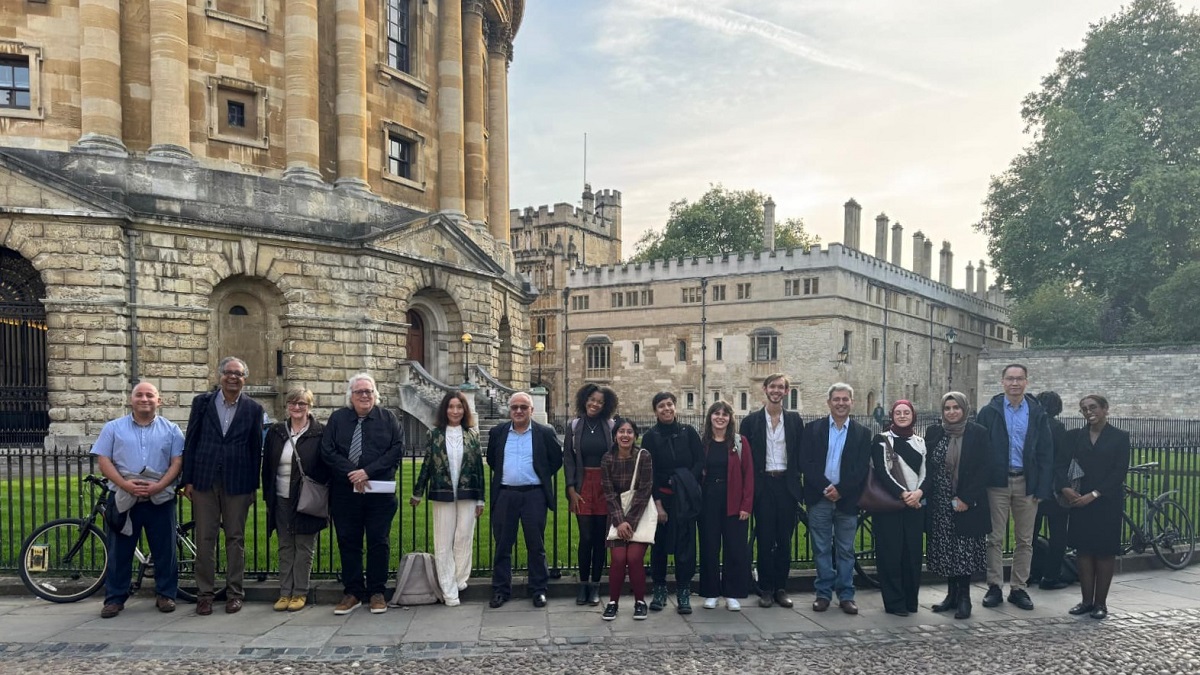
On 19th September, scholars, researchers and practitioners gathered in Mansfield College, Oxford, for a workshop on Intergenerational Dialogue for Well-Being Futures. This event was co-convened in partnership with the Journal of Dialogue Studies, which will publish a special issue (Vol. 14, 2025) on the same theme.
My motivation for guest-editing this issue arises from five years of work with the UNESCO Collective Healing Initiative. At the heart of Initiative are the Collective Healing Circles (CHCs), intergenerational spaces created in communities across Africa, the Americas, and Europe. In these circles, people of all ages come together to acknowledge historical mass atrocities, recognise continued wounds, reclaim ancestral wisdom and human dignity, transcend divisions, and co-imagine shared flourishing. They have shown me both the transformative potential and the challenges of intergenerational dialogue and inspired me to bring these questions into wider academic and policy exploration.
A workshop structured as a journey
Following an inspiring keynote from Youssef Mahmoud, former UN Under-Secretary-General, the academic workshop’s programme followed a deliberate arc:
- Contexts – situating dialogue in linguistic, historical, ethical, grassroots, digital, and spiritual arenas.
- Conceptualisations – examining how intergenerational dialogue is conceived epistemologically, ethically, and culturally, and how it can serve healing, and transformation.
- Practices – exploring how dialogue is enacted and transmitted through arts, memory, and creative media.
- Futures – considering how intergenerational dialogue might serve as a foundation for justice, solidarity, and flourishing societies.
This progression created space not only for rich scholarly exchange, but also for deep reflection on the ethical, methodological, and political dimensions of dialogue across generations.
Insights across the sessions


Several themes resonated across the day:
- Transmission and transformation: Dialogue mediates the tension between preserving ancestral wisdom and inherited knowledge and transforming it for the future.
- Agency and co-authorship: Who has the authority to decide what is remembered, transmitted, or reinterpreted? Intergenerational dialogue demands genuine co-authorship.
- Dialogue as ethical practice: Listening, translation, ritual, and creativity are not just methods, but ethical commitments.
- Challenges of reconciliation: Dialogues are often uncomfortable — grappling with guilt, silence, or denial — yet necessary for relational repair.
- Futures through justice: Dialogue is not only about the past; it is a path to recognition, resilience, and flourishing futures.
One aspect that remains insufficiently addressed is the overwhelming domination of structural injustice, which continues to define the lived experience of the global majority. While academic research offers decolonial critique and systemic analysis, the challenge ahead lies in reimagining global governance that can respond to these realities.
Looking ahead
For me, one of the most moving aspects of the workshop was how much it echoed the spirit of the UNESCO Collective Healing Circles. We saw how dialogue is never neutral: it carries risks of stereotyping or tokenising, but also profound possibilities for recognition, resilience, and transformation. We saw how young people are not simply listeners or translators, but co-creators of meaning and futures. And we saw how elders are not only custodians of memory, but partners in reshaping change.
As we move forward, the next step is to revise and deepen the papers in light of the workshop conversations. Guided by the Journal of Dialogue Studies framework, the special issue will ensure that contributions are theoretically rich, methodologically and ethically strong, and — most importantly — relevant to the question at the heart of our gathering: how intergenerational dialogue can nurture well-being futures in contexts marked by structural injustice.
I am grateful to all who joined us in Oxford, for your generosity, insights, and presence. This is not the end, but part of a continuing journey to explore and enact intergenerational dialogue as a vital resource for our shared futures.
You must be logged in to post a comment.