UNESCO Routes of Enslaved People 30th Anniversary

The GHfP Institute was delighted to join UNESCO in celebrating 30 years of the Routes of Enslaved Peoples (REP) Programme in Paris in October 2024.

At this extraordinary event, the GHfP co-organised the presentation of the UNESCO partnership initiative on Collective Healing, Just Society and Global Well-Being. The Collective Healing Initiative is committed to addressing the legacies of dehumanisation, e.g. slavery, colonialism, and indigenous genocide, and other historically rooted injustice, through facilitating and encouraging community-based Collective Healing Circles (CHCs) currently active in 14 countries globally. The initiative is co-sponsored by the UNESCO Social and Human Sciences Sector and the Guerrand-Hermès Foundation and is coordinated by the GHfP Institute.

Group of five individuals posing together in front of a UNESCO sign at an event, showcasing diverse attire and smiles.

Our presentation consisted of testimonies and narratives provided by community representatives from four continents (Brazil, Nigeria, the UK, the USA and France/Martinique) who shared their experiences of intergenerational approach to healing, dignity and well-being. They invited the high-level global leaders to consider ways to transform societies and to ensure structural justice. This event further saw UNESCO Assistant Director General (ADG), Mrs Gabriela Ramos launching the Collective Healing Circle Programme Handbook for Facilitators. The development of this Handbook was supported by grants from the Guerrand-Hermès Foundation for Peace, the Fetzer Institute, and the Pureland Foundation. The Handbook is intended to support the efforts of facilitators and other professionals who are interested in hosting Collective Healing Circles (CHCs) in their local community.


presenting the collective-healing handbook at UNESCO in 2024

Following the presentation, community CHC practitioners and presenters engaged in a deep dialogue with high-level national leaders on the opportunities to engage other stakeholders in this joint efforts towards creating a fair, inclusive and just world for our present and future generations.

GHfP Institute @UNESCO HQ – Launching Collective Healing Handbook

On 10th October 2024, UNESCO Assistant Director General, Mrs Gabriela Ramos, launched the Collective Healing Handbook for Facilitators in Paris, to mark the 30th Anniversary of UNESCO Routes of Enslaved People’s Programme.

The research and development of this Handbook was supported by grants from the Guerrand-Hermès Foundation for Peace. The Handbook is intended to support the efforts of facilitators and other professionals who are interested in hosting Collective Healing Circles (CHCs) in their local community. The intellectual insights underpinning the CHCs proposed in this Handbook are drawn from contemporary research on historical atrocities, such as the transatlantic trade of enslaved Africans, colonialisation, and mass killing and violent displacement of Indigenous peoples, as well as the legacies of dehumanisation, such as racism and structural injustice.

The practical ideas for implementing the CHC Programme featured throughout the Handbook are inspired by existing proven approaches of similar programmes, and those which have emerged from a one-year pilot of the Programme in five countries (Kenya, Nigeria, the UK, the USA and Colombia) on four continents. Click the link below to download the CHC Programme Handbook for Facilitators.

The launch was followed by reports and testimonies from community partners and participants of the UNESCO Collective Healing Initiative on the process and impact of our CHC activities on four continents.

Amongst those in the audience at UNESCO HQ were global leaders, national delegations, and civil society representatives.

Geneva Peace Week Ethics Education Workshop Registration Open

In an increasingly globalized world where indicators of inter-group tensions are worsening and there is increasing xenophobia, discrimination and bullying in schools and communities,  education should provide children with peace-building tools and skills as well as nurturing ethical values.  Data shows, that there is an increase in bullying motivated by prejudice against someone’s actual or perceived race, ethnicity, culture, citizenship status or religion. This type of bullying is associated with a wide range of negative outcomes including poor mental health, lower academic engagement, and an increased risk of involvement in delinquent behaviours, especially among older learners.  Ethics education and its transformative pedagogy have demonstrated proven results to develop safe learning environments, support children’s sense of meaning and purpose, improve children’s relationships across religious, ethnic and cultural backgrounds, ultimately equipping them to develop a sense of solidarity, building trust, and enhancing social relations to address polarization, division and fear of the other in communities.

This session is a highly interactive workshop based on the ethics education transformative pedagogy, which provides the opportunity to acquire knowledge, practice skills, learn from one another, and co-create learning together.  The workshop will contribute towards engaging in a narrative analysis about structural and cultural violence in schools, as well as will aim to contribute to generate reflections on how schools can become champions of peace through interactive pedagogical approaches, inclusive learning environments, dialogue approaches, children-led solutions, community engagement and a whole-school approach.

Register here to book your place – all sessions will be available onsite and online : https://www.genevapeaceweek.ch/en/programme/schedule/addressing-discrimination-and-xenophobia-in-schools-through-ethics-education?_gl=1*1dt07ug*_up*MQ

Building a Global Healing Alliance 

Throughout April 2024, experienced facilitators from across the world have been brought together by the UNESCO Collective Healing Initiative in a major step towards creating a global healing alliance of community-rooted Collective Healing Facilitators.

The UNESCO Collective Healing Capacity Building Programme prepares participants to understand the key theoretical and methodological ideas underpinning the Collective Healing Initiative and builds their capacity to design and host bespoke Collective Healing Circles in their local communities.  

Thanks to the support and generosity of the Global Humanity for Peace InstituteGuerrand-Hermès Foundation and Fetzer Institute, the capacity building programme in April has brought together 25 participants from across 5 continents, including representatives from Brazil, Colombia, Costa Rica, Uruguay, USA, Mexico; Martinique & Guadeloupe; France, UK and Germany; and Kenya, Nigeria and Cameroon. The group includes voices from African, Afro-Caribbean, African-American, European-descent, and Indigenous communities. Participants engaged in a multi-lingual online space, with live simultaneous interpretation available in English, French, Spanish and Portuguese at all times. 

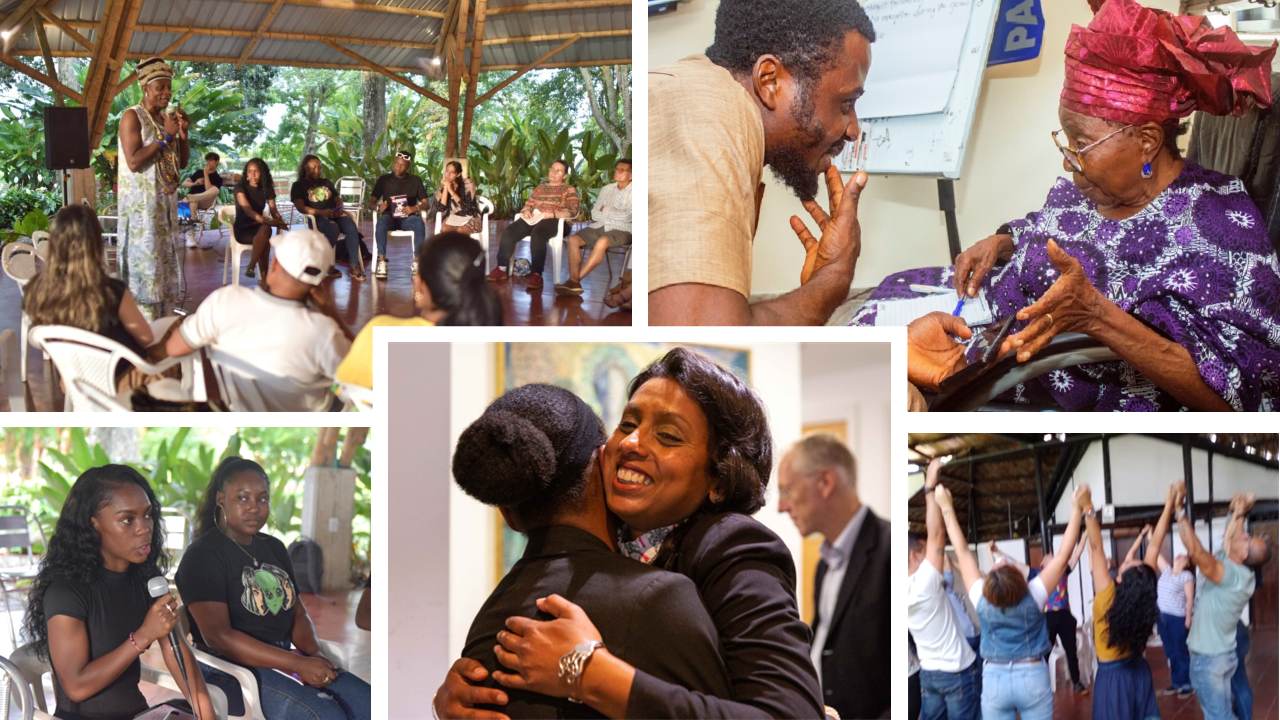
The online capacity building space is one which celebrates rich diversity, whilst also deeply acknowledging the shared experiences of loss, trauma and displacement which pervade the history of all cultures. Through experiential and dialogue-based sessions, participants have been guided through the four interlocking modules which form the structure for the collective healing circles: 1) Acknowledging our shared histories of dehumanisation and recognising their enduring legacies and harms​; 2) Restoring our sense of human wholeness and re-affirming our dignity​; 3) Strengthening relationships & deepening interconnectedness; and 4) Envisioning structural justice & activating our responsibilities for shared future(s). These modules work together to initiate and sustain collective healing within communities whose history has been characterised by structural dehumanisation, displacement, racism and inequality, towards a shared future of social justice and holistic wellbeing. 

As one of the team shared:

This capacity building programme is so much more than a ‘training’; it is a space for mutual sharing and learning, where each participant is bringing their many years of experience and cultural treasure to the space. Each session opens and closes with a participant sharing a cultural practice or ritual from their community – we have shared poems, songs, Indigenous chants… Each of us feels honoured to be in the space together and we are building bonds and friendships that will sustain us and our communities for many years to come.” 

Following completion of the capacity building programme, participants will continue to develop community-rooted UNESCO Collective Healing Circles, with the ongoing guidance of experienced UNESCO Collective Healing Mentors. All participants completing this cycle will be awarded a UNESCO Collective Healing Initiative Certificate of Achievement in formal recognition of their role as UNESCO Collective Healing Circle Facilitators. A waiting list for participation in the next capacity building opportunity is already growing. 

Introduction to Collective-Healing facilitator capacity building.

The UNESCO Collective Healing Circles (CHCs) Capacity-Building for Facilitators is designed to support and nurture experienced facilitators who have interest in hosting UNESCO CHCs in your local community.

Below is a short introduction to the UNESCO CHC Facilitators Capacity Building, including:

  • background
  • theoretical underpinnings
  • community contexts
  • innovative features
  • CHC processes and modules
  • CHC capacity building facilitators mentors
  • outcomes

It is highly recommended that all facilitators who wish to take part in the UNESCO CHC Capacity Building watch this less-than 15 minutes Introduction presented by the UNESCO CHC Facilitator Mentors.

The Introduction is available in the following languages: English, French, Portuguese and Spanish.