A Global Study on Futures-Forming Leadership

This year, the GHfP Institute has engaged in a global study, commissioned by UNESCO, to explore youth’s needs for leadership development. What marks this research unique is that it has involved youth co-researchers throughout, from identifying research questions, to designing the research questionnaire, from hosting focus-groups, to analysing the data and identifying themes and proposing recommendations. Furthermore, this global study intentionally focuses on the voices of youth from marginalised communities.

Over 1,500 young people across every world region contributed to this research through a desk review, survey questionnaire, focus groups, and in-depth interviews. Their message is clear: leadership must be reimagined. No longer hierarchical, elitist, or tokenistic, youth envision leadership as relational, dialogical, and futures-forming — a practice that is grounded in care for people and the planet. In fact, this study reveals that young people are already leading change today, often under extraordinary constraints, and more importantly, they are leading with visions of justice, dignity, and well-being that the world urgently needs to hear.

What Youth Told Us

  • Their concerns are urgent and overlapping. From climate change and unemployment to gender-based violence, mental health, and political exclusion, young people confront intersecting crises every day.
  • They are already leading. In their communities, youth are mobilising for climate justice, creating safe spaces, preserving culture, and challenging systemic injustice.
  • Barriers are structural, not personal. Youth are not held back by a lack of talent or ambition, but by ageism, tokenism, underfunding, weak civic spaces, and exclusionary education systems.
  • They know what enables leadership. Trust, mentorship, intergenerational solidarity, sustained resources, and spaces of safety and belonging emerged as essential conditions for flourishing.
  • They are re-framing leadership itself. Leadership, they argue, is not about power over others, but about dialogue, shared responsibility, and accountability to future generations.

A Blueprint for Futures-Forming Leadership

From these insights, the study distilled:

  • Three imperatives: address systemic injustice, strengthen intergenerational solidarity, and reimagine governance for the common good.
  • Five values: collective well-being, dialogue, relationality, justice, and responsibility to future generations.
  • Seven proposals: practical recommendations from youth, ranging from experiential learning and mentoring to sustainable funding and co-governance structures.

Together, these constitute a youth-authored blueprint for leadership that is capable of meeting the challenges of our time.

A Call to Action

Young people are not asking for charity. They are calling for recognition, resources, and authentic partnership. They ask institutions to:

  • Institutionalise youth co-governance.
  • Secure long-term funding and seed grants.
  • Embed youth leadership into UNESCO and partners’ core systems.
  • Build decentralised hubs for exchange and solidarity.
  • Leverage partnerships across sectors to scale impact.

Why This Matters

Leadership for the future cannot be postponed. The crises we face are urgent, and the creativity and courage of youth are already shaping the path forward. What is needed now is not another round of rhetoric, but a living covenant between generations — a commitment to co-create futures where dignity, justice, and flourishing are shared by all.

UNESCO’s Futures-Forming Leadership Report amplifies the voices of young people. The responsibility lies with us — institutions, funders, educators, policymakers — to act on what they have said.

Because youth are not the leaders of tomorrow. They are the leaders of today.
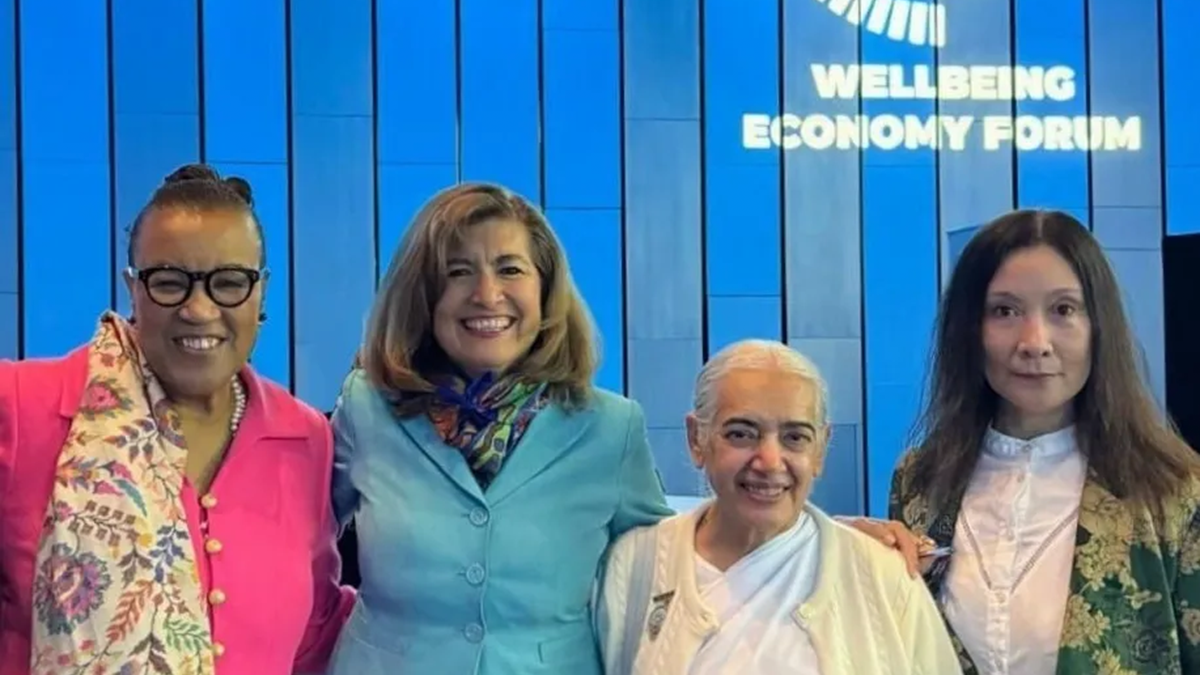
Meeting Baroness Patricia Scotland during 2025 Well-Being Economy Forum

Scherto Gill, Director, Global Humanity for Peace Institute

During 2025 Well-Being Economy Forum, held on 8-9 May in Reykjavik, Iceland, I had a unique opportunity to meet with Rt Hon. Baroness Patricia Scotland, KC, former Secretary-General of the Commonwealth Secretariat.

In our conversation, I have learned that Baroness Scotland’s leadership approach was particularly innovative and effective, especially three non-negotiable strategies for twenty-first-century multilateralism: build coalitions, seek prevention rather than mere reaction, and put new technology to work for the common good.

On building coalition for collaboration, she shared the example how she coordinated the signing of the Apia Commonwealth Ocean Declaration. Pulling together 49 coastal states, land-locked African members, green NGOs and the world’s second-largest shipping registry (Palau), Baroness Scotland secured the Commonwealth’s first-ever ocean treaty text, complete with 30 × 30 conservation goals and a guarantee that rising seas will not wash away maritime boundaries. The achievement was possible only because she had already nurtured ten country-led Blue Charter “action groups”, so the technical arguments were owned by ministers themselves before leaders arrived in Samoa.

That same owner-driven formula underpins the Connectivity Agenda. Instead of issuing top-down prescriptions, Scotland persuaded trade officials from five regional clusters—digital, physical, regulatory, supply-side and B2B—to write each other’s policy toolkits. The prize they chase together is a US $2 trillion intra-Commonwealth trade target by 2030.

Even inside the Secretariat she practised “co-create first, announce later”. The virtual Commonwealth Pro Bono Centre was co-designed by 14 least-developed members and six global law firms; on launch day Malawi’s Attorney-General called it “an invaluable resource that levels the negotiating table”.

Her focus on prevention rather than reaction was marked by her developing the flagship Climate Finance Access Hub. By embedding advisers directly inside ministries, the Hub helped small states raise US $384 million with another half-billion in the pipeline—money aimed at cyclone-resilient roads, mangrove buffers and drought-proof farms before the next cataclysm hits.

Prevention also animated Commonwealth Says NO MORE, the first pan-Commonwealth platform against gender-based violence. Instead of crisis hot-lines alone, the campaign arms local leaders with by-stander training, economic-cost calculators and a referral app designed to stop violence upstream.

Dedicated to the common good, Baroness Patricia developed a project aimed at “Strengthening the Adaptive Capacity of Coastal Communities of Fiji to Climate Change through Nature-Based Seawalls”. Traditionally, coastal-defence proposals from small islands can take 4 years to assemble and 2 years to approve. However, under the coordination of Baroness Scotland, this project took barely one year. Indeed, with the assistance of AI and scenario simulations, providing evidence pack, Fiji filed a full grant request to the Adaptation Fund in October 2023; by 19 April 2024 the Board had approved US $5.7 million for construction. The project will build the 4 km hybrid seawall, restore adjoining mangrove belts and train local youth as shoreline-monitoring rangers.

The Fiji seawall development process is a living case study of her preventative, tech-forward, common-good centred approach to multilateral governance.

Baroness Patricia Scotland stepped down as Commonwealth Secretary-General on 31 March 2025; Ghana’s Shirley Ayorkor Botchwey takes over on 1 April 2025.

Advancing Positive Peace in a Fractured World: Reflections from the GHfP Institute’s 2024 Achievements

The year 2024 was a paradoxical one. As global conflicts deepened and social inequalities widened, efforts towards positive peace, well-being, and collective healing gained momentum. The Global Humanity for Peace (GHfP) Institute has been at the forefront of these efforts, fostering transformative research, facilitating intergenerational dialogue, and nurturing changemakers committed to reimagining more just and harmonious societies.

Shaping the Future of Peace and Well-Being

At the core of our work is a commitment to positive peace—a concept that extends beyond the absence of conflict to embrace social justice, intergenerational healing, and ecological integrity. Through research, symposia, and policy advocacy, we have sought to bridge divides, empower communities, and reframe governance structures toward values of dignity, dialogue, and care.

1. Advancing Research on Positive Peace

One of our key research areas in 2024 focused on the Pacific’s vision of an Ocean of Peace. Working alongside colleagues from leading UK universities, we explored how peace studies can support indigenous-led efforts to nurture peace as an ethos woven into governance and daily life. This research offers critical insights for regions beyond the Pacific—where tensions and ecological crises demand fresh approaches to peacebuilding.

Our commitment to positive peace also led us to facilitate high-level discussions, such as the International Symposium on Peace in the Middle East, which we co-convened in London, and a panel on the same topic that we presented during the annual Imagine Peace Forum in Iceland. Amidst the backdrop of escalating conflict, these platforms provided rare and necessary spaces for dialogue, exploring how relational peace processes can overcome entrenched divisions.

2. Healing the Harms of Inhumanity

For over three years, the GHfP Institute has played a pivotal role in the UNESCO Collective Healing Initiative, developing intergenerational dialogue & inquiry (IDI) methodologies to address the historical and ongoing harms of structural injustice. In 2024, our Collective Healing Circles (CHCs) expanded in communities in 14 countries across 4 continents, offering a structured yet deeply transformative process of communal healing and contributing to the well-being of future generations.

Our newly launched Handbook for CHC Facilitators & Co-Creators, presented at the UNESCO 30th Anniversary of the Routes of Enslaved Peoples, is now a key resource for collective healing practitioners worldwide. The CHCs—led predominantly by women and youth—are proving to be caring spaces where communities can acknowledge past traumas, restore dignity, and co-imagine just futures.

3. Rethinking Governance for Human and Planetary Flourishing

In a world where political and economic systems often prioritize short-term gains over collective well-being, we have continued our efforts to articulate principles of well-being governance. Our latest publication, Beyond Instrumentalised Politics, proposes an alternative vision—one where governance is guided by non-antagonism, equality, and a deep commitment to the well-being of all.

These ideas underpinned our plenary session at the UNESCO Well-Being of Future Generations Forum, where we engaged policymakers, scholars, and youth leaders in co-constructing pathways for a future where governance is not merely about managing crises but about fostering societal transformation.

4. Transforming Education for Well-Being Futures

Education remains central to our vision for positive peace. In collaboration with the Fetzer Institute, we conducted research into how relational approaches in schools can enhance student well-being. Our findings are informing global efforts to integrate caring and ethics-based education into curricula, ensuring that schools nurture not only academic success but also emotional and moral resilience.

As part of this commitment, we are proud to be a research partner in the Ethics Education Fellowship Programme, working with six ministries of education in Asia and Africa. This initiative is a testament to our belief that education is not just about preparing for the future but about shaping it.

Looking Ahead: A Call to Action

The challenges we face today—from environmental degradation to erosion of democracy, and to youth disempowerment—are complex, but they are not insurmountable. The work of the GHfP Institute in 2024 has demonstrated that peace, healing, and politics of dignity are not abstract ideals but lived realities that we can co-create.

As we move into 2025, we invite partners, educators, policymakers, and communities to join us in advancing this vision. Whether through research collaborations, policy dialogues, or grassroots peace initiatives, each effort contributes to a larger movement towards a world where peace is not just the absence of war, but the presence of justice, dignity, and well-being for all.

Site Icon

Conference on Resolution of Intractable Conflict, 2024

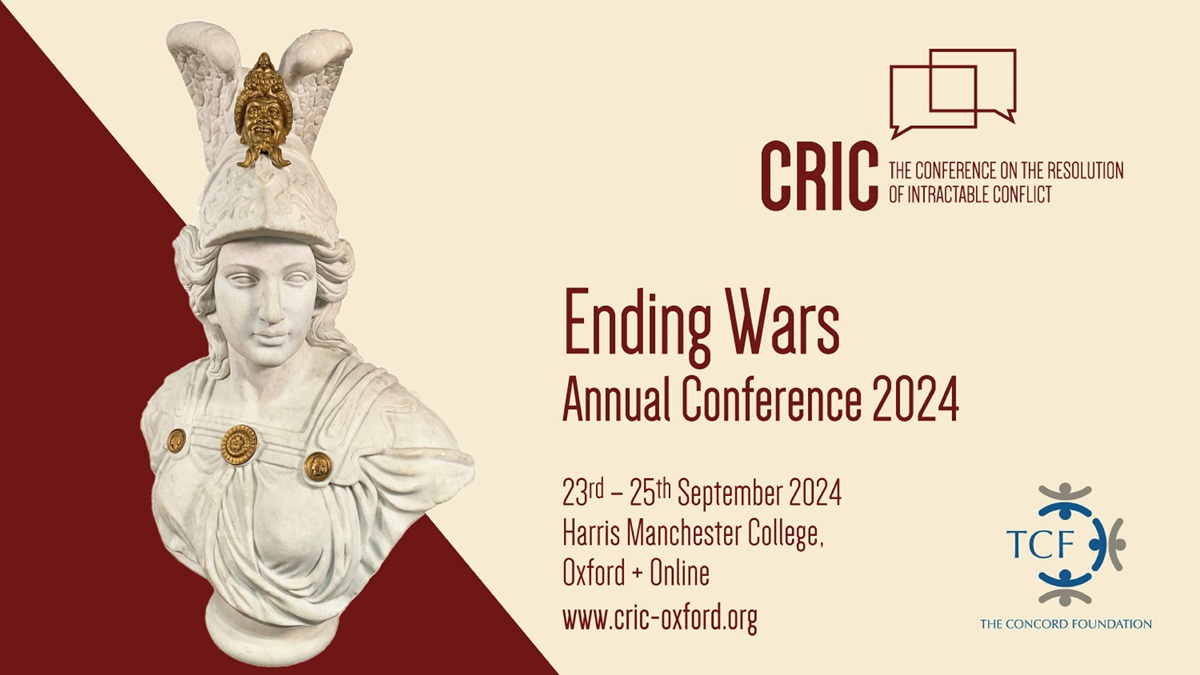
The GHfP Institute is a partner of the annual Conference on Resolution of Intractable Conflict. The 2024 CRIC was held on 23rd to 25th September at Harris Manchester College, University of Oxford. This was the 11th Annual Conference which took place amid deepening concerns about the deteriorating geopolitical tensions. Hence the theme of 2024 CRIC was “Ending Wars” to address two perspectives –

  1. Exploring whether it is possible that out of the immediate worldwide crises of war and climate catastrophe a new approach can be fashioned to deal with our deepest differences, as was the case, albeit not permanently, after the two global conflicts of the first half of the 20th century.
  2. Reflecting on if we are to understand how the current specific and overlapping wars can be closed down.

Day 1 Playlist

https://www.youtube.com/playlist?list=PLOcZWrzWgUWvMb-CFtsezVepXFgfCpOSP

Day 2 Playlist

https://www.youtube.com/playlist?list=PLOcZWrzWgUWtuCruZ8Z5OupfL4zXHGYeY

Day 3 Playlist

https://www.youtube.com/playlist?list=PLOcZWrzWgUWsZdG7oQxg-pz5KxljbNaji


Minerva, the Roman goddess of war was used as a symbol of CRIC 2024. She is also of goddess of wisdom, art, justice and commerce. Can we bring wisdom to bear on the problem of war?

about CRIC the conference series, introduced by Lord John Alderdice

Watch the CRIC channel: https://www.youtube.com/@cric-oxford

Governance for the Human Future: The Centrality of Dialogue

Past event, September 2022.

The Journal of Dialogue Studies, in partnership with the Global Humanity for Peace Institute, invited papers that explore the ways governance processes might be improved by drawing on insights from innovative dialogue theories and congenial dialogue practices.

These papers were presented in an International Academic Workshop entitled Governance for the Human Future: The Centrality of Dialogue on the 10th of September 2022, 9 am BST.

In this workshop, there were 14 abstracts critically addressing the following themes to explore the ways international governance processes might be improved by drawing on insights from innovative dialogue theory and good dialogue practices.

  1. How might dialogue theory and good dialogue practices contribute positively to the governance processes? In what ways might these insights be applied effectively to governance?
  2. How significant are various theories of dialogue for governance processes? How might these dialogue theories be further developed and enriched?
  3. What dialogue practices might make positive contributions to good governance? How do they do so?
  4. What are the major impediments to meaningful dialogues? How might they be overcome?
  5. What might we learn from non-western approaches to good governance? How is dialogue practised in these approaches?
  6. How might good dialogue practices transform governance processes?

Editorial Board

  • Prof Scherto R. Gill, University of Wales Trinity Saint David
  • Prof Edward Abbott-Halpin, The University of the Highlands and Islands
  • Dr Ali Moussa Iye, Afrospectives and Former UNESCO Routes of Dialogue Chief
  • Dr Sara Silvestri, City, University of London
  • Prof Garrett Thomson, Guerrand-Hermes Foundation, and The College of Wooster
  • Prof Paul Weller, Universities of Coventry and Derby, and Regent’s Park College, University of Oxford

Programme

Session 1: Dialogue Theories and Governance (9:30–11:00)

Keynote
Prof Kenneth Gergen, President of the Taos Institute and Chair of the Board and the Mustin Professor of Psychology at Swarthmore College

Theoretical Approaches on the Role of Dialogue in International Governance: A Review of the Literature
Dr Patrice Brodeur, Associate Professor at the Institute of Religious Studies, University of Montreal

Dialogues as Consensus-Building for Governance: A Conceptual Analysis
Prof Garrett Thomson, CEO Guerrand-Hermes Foundation and Professor of Philosophy at the College of Wooster

Water Diplomacy and Governance: Philosophical Perspectives and Political Implications
Dr Medha Bisht, Associate Professor at the Department of International Relations, South Asian University, New Delhi

Session 2: Dialogue Practices in Governance (11:15–13:00)

Special Tribute to Dr Steve Wright — ‘The Wright Way for Dialogue’
Prof Simon Lee, The Open University and Professor of Jurisprudence, Queen’s University Belfast
Prof Edward Abbott-Halpin, Principal of Orkney College, University of the Highlands and Islands

Harnessing Performative Knowledge to Achieve Fruitful Dialogue: The Participatory Arts-Based Approach
Dr Barbara Groot, Senior Researcher at the Leyden Academy on Vitality and Ageing, Leiden University Medical Centre
Prof Tineke A. Abma, Professor for Participation at the Leiden University Medical Centre, and Executive-Director of the Leyden Academy on Vitality and Ageing

The 30th Anniversary of a Grassroots Dialogue in Northern Ireland
Prof Simon Lee, The Open University and Professor of Jurisprudence, Queen’s University Belfast

Conversation as a Methodology for Human Flourishing, Belonging, and Understanding
Dr Saiyyidah Zaidi, Convenor at the Centre for Belonging and Understanding and a Faculty Member and Tutor with Meyler Campbell

The Case of the Popular University of Social Movements: Lessons on Dialogue from and for Humanisation and the Transformation of Traditional Institutions
Alexandre da Trindade E Oliveira, Doctoral Student at the Faculty of Education, University of Cambridge

Session 3: Challenges of Meaningful Dialogue in Governance (14:00–15:30)

Keynote: Dialogue and the Route to Relational Governance
Prof Kenneth Gergen, President of the Taos Institute and Chair of the Board and the Mustin Professor of Psychology at Swarthmore College

Ready for a Perfect Storm: Leadership, Dialogue and Trust in a Time of Disconnection
Prof Mike Hardy, Chair of Intercultural Relations and Founding Director of the Centre for Trust, Peace, and Social Relations at Coventry University
Dr Uroosa Mushtaq, Doctoral Fellow (Cotutelle), Centre for Trust Peace and Social Relations at Coventry University

Digital Media and Problems of Fragmentation, Rise of Populism and the Post-Truth Era
Dr Serik Orazgaliyev, Associate Professor at the Graduate School of Public Policy, Nazarbayev University and Research Affiliate at the Cambridge Central Asia Forum, Jesus College, University of Cambridge

Dialogue and the Document on Human Fraternity: ‘Academic’ Scriptural Reasoning as a Tool for Promoting International Governance
Ahmed Ragab Abdelhay, Assistant Lecturer at Al-Azhar University and Professional Doctorate Student at the University of Wales Trinity Saint David

Cultural Democracy at the Frontiers of Patronage: Public Interest Art versus Promotional Culture
Dr Owen Logan, Honorary Research Fellow in the University of Aberdeen’s School of Divinity, History, Philosophy and Art History
Dr Martyn Hudson, Assistant Professor in Art and Design History at Northumbria University, Newcastle
Prof Alex Law, Professor of Sociology at the School of Business, Law and Social Sciences, Abertay University
Dr Kirsten Lloyd, Lecturer in Curatorial Theory and Practice at The University of Edinburgh

Session 4: Innovative Approaches to Good Governance in non-Western Contexts (15:45–17:30)

From the inside out: The “culture of dialogue” among pro-democratic actors in Equatorial Guinea
Carolina Nvé Díaz San Francisco, Doctoral Student in Anthropology, Universidad Nacional de Educación a Distancia and A Researcher at the Disparities Research Unit (Massachusetts General Hospital, Harvard Medical School)

Democracy and Dialogue in India: The Minority Discourse
Dr Sneha Roy, Programme Officer at the KAICIID International Dialogue Centre

Dialogue and the Document on Human Fraternity: ‘Academic’ Scriptural Reasoning as a Tool for Promoting International Governance
Ahmed Ragab Abdelhay, Assistant Lecturer at Al-Azhar University and Professional Doctorate Student at the University of Wales Trinity Saint David

Public Policy, Collaborative Governance, and Female Entrepreneurship in the Caribbean: A Critical Assessment
Dr Talia R. Esnard, Senior Lecturer and Head of Department of Behavioural Sciences at The University of the West Indies, Trinidad and Tobago

A Book of Abstracts was produced for this workshop.